
Experienced Restorative Dentistry in Bountiful, UT
Helping You Achieve Healthy, Happy Smiles!
At Dental Designs of Bountiful, we want to help you achieve a lifetime of smiles, filled with health and happiness!
During your first dental examination with x-rays, you will be given the opportunity to discuss your dental health and goals. What is important to you, is priority for us. You will be presented with options to meet your dental goals. We offer many different services. But, you will be invited to join the decision-making process of what dental treatment will work best for you. In partnership with our dentists, you will have a healthy smile and know you were a part of the process. Leaving the dental office feeling confident and informed of your dental plan is our goal.

We can’t wait to meet you and start building a friendship while helping you achieve a healthy, happy, beautiful smile.
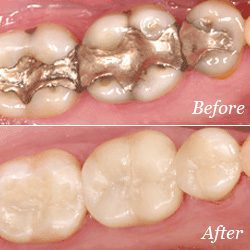
Crowns are a restorative procedure used to improve your tooth’s shape or to strengthen a tooth. Crowns are most often used for teeth that are broken, worn, or have portions destroyed by tooth decay.
A crown is a “cap” cemented onto an existing tooth that usually covers the portion of your tooth above the gum line. In effect, the crown becomes your tooth’s new outer surface. Crowns can be made of porcelain, metal, or both. Porcelain crowns are most often preferred because they mimic the translucency of natural teeth and are very strong.
Crowns or onlays (partial crowns) are needed when there is insufficient tooth strength remaining to hold a filling. Unlike fillings, which apply the restorative material directly into your mouth, a crown is fabricated away from your mouth. Your crown is created in a lab from your unique tooth impression, which allows a dental laboratory technician to examine all aspects of your bite and jaw movements. Your crown is then sculpted just for you so that your bite and jaw movements function normally once the crown is placed.
We understand the inconvenience patients face with a traditional crown, and because your time is as valuable as your smile, we now use a revolutionary tool that mills a permanent crown in about an hour: E4D.
How E4D Works:
After taking a 3D image of your tooth, our E4D machine can mill a strong, beautiful restoration in about an hour. We’ll permanently place the crown during your single visit, and you’ll leave our office with a full, healthy smile.
Millions of patients worldwide have experienced the convenience of E4D crowns. E4D Blocs, the material from which the crowns are milled, are backed with 20 years of research, so you can rest assured they offer a durable restoration that you can trust. E4D can also mill inlays, onlays, and veneers for your convenience. Ask us about E4D crowns today so you can spend less time in the dentists chair and more time sharing your smile.
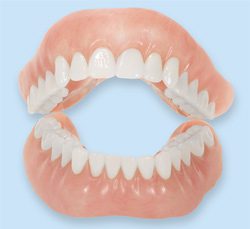
Dentures are natural-looking replacement teeth that are removable. There are two types of dentures: full and partial. Full dentures are given to patients when all of the natural teeth have been removed. Partial dentures are attached to a metal frame that is connected to your natural teeth and are used to fill in where permanent teeth have been removed. Just like natural teeth, dentures need to be properly cared for. Use a gentle cleanser to brush your dentures, always keep them moist when they’re not in use, and be sure to keep your tongue and gums clean as well.
Many times, we hear from new patients that when they left other dental offices, they had more questions than answers. As a valued patient, every question and concern you have is important and each will be answered to your satisfaction.
Partial crowns, often referred to as only ones, are a type of dental restoration or porcelain filling that covers one or more cusps of your tooth. Onlay’s are also made of porcelain by a lab and take two appointments to complete. An inlay is like a dental filling, but the restoration is made of porcelain by a lab and is placed within the cusps on a tooth’s chewing surface. These restorations are much more conservative than crowns and can be imperceptible from your natural tooth. However, the use of onlays and inlays is limited to very specific situations and is not as common as a dental crown.
What is a Dental Inlay?
An inlay is a lab-fabricated porcelain filling that fits into the grooves of a tooth and does not extend over the cusps of the tooth. The patient is numbed using a local anesthetic and the dentist drills the tooth to remove and clean out the decay in the tooth. This is one of the restorative methods used to repair a tooth after it sustains harm from injury or decay that does not affect the cusps of the tooth. The dentist takes an impression and sends it to a laboratory where the inlay is made.
Inlays are manufactured from porcelain or composite resin material matching the color of the tooth and provide almost invisible dental restoration while repairing the chewing surface. Dental inlays are generally more durable than regular fillings made from composite or amalgam.
What is a Dental Onlay?
Onlays also fit inside the tooth but extend onto the chewing surface of a back tooth to replace one or more cusps. In the past, onlays were made only of gold, but like inlays, more and more patients requested a tooth-colored onlay. Making the onlay of ceramic/porcelain allows the restoration to be bonded to the tooth.
This bonding process may improve the strength of the tooth and help seal the onlay to the tooth. Sometimes It is difficult to determine when inlays or onlays can be used instead of crowns or caps. But, you are in great hands as our dentists will review all your options with you to determine the best dental plan.
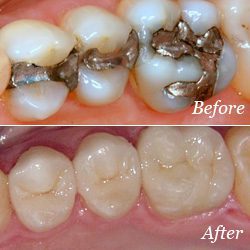
Traditional dental restoratives, or fillings, are most often made of silver amalgam. The strength and durability of this traditional dental material make it useful for situations where restored teeth must withstand extreme forces that result from chewing, often in the back of the mouth.
Newer dental fillings include ceramic and plastic compounds that mimic the appearance of natural teeth. These compounds, often called composite resins, are usually used on the front teeth where a natural appearance is important, but they can also be used on the back teeth depending on the location and extent of the tooth decay.
There are two different kinds of fillings: direct and indirect. Direct fillings are fillings placed into a prepared cavity in a single visit. They include silver amalgam, glass ionomers, resin ionomers, and composite (resin) fillings. Indirect fillings generally require two or more visits. They include inlays, onlays, and veneers. They are used when a tooth has too much damage to support a filling but not enough to necessitate a crown.
An endodontist’s goal is often to save a tooth that might otherwise need to be extracted. They specialize on treating the pulp, the soft part of the tooth underneath the hard enamel exterior.
When a tooth is cracked or has a deep cavity, bacteria can enter the pulp. These germs can cause an infection inside the tooth. Infected or damaged pulp can cause severe tooth pain and swelling. If left untreated, the whole tooth may need to be removed. Instead, your tooth can be saved with root canal therapy and other procedures.
How does root canal therapy save my tooth?
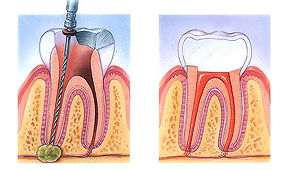
- An opening is made through the crown of the tooth into the pulp chamber.
- The pulp is removed, and the root canals are cleaned, enlarged and shaped.
- Medications may be put in the pulp chamber and root canal(s) to help get rid of germs and prevent infection. You might be given other medicine to keep infection from spreading.
- A temporary filling will be placed in the crown opening to protect the tooth between dental visits. Your dentist may leave the tooth open for a few days to drain.
- The temporary filling is removed, and the pulp chamber and root canal(s) are cleaned and filled.
- Finally, a permanent filling or a gold or porcelain crown is placed over the tooth.
Full-mouth reconstruction, full-mouth rehabilitation, and full-mouth restoration are terms often used interchangeably to describe the process of rebuilding or restoring all of the teeth in both the upper and lower jaws simultaneously. Your dentist, who has years of experience working with the materials and procedures related to full-mouth reconstruction, will develop a plan that addresses all your needs and will leave you with a perfect smile, ideal bite, and optimal function.
You may be a candidate for full-mouth reconstruction if:
- Your teeth have been lost due to decay or trauma
- Your teeth have been injured or fractured
- Your teeth have become severely worn because of long-term acid erosion (from foods, beverages, or acid reflux)
- You have ongoing jaw, muscle, or headache pain related to your bite
The extent of your reconstruction will depend on the condition of your teeth. Your dentist may recommend crowns, bridges, veneers, or implants to restore your smile to its best possible condition. He or she will also address the state of your gum tissue, as the health of your gums may impact the type of restorations you receive.
Your treatment plan will entail a step-by-step process detailing all aspects of your reconstruction. The duration of your treatment will depend on the extent of work needed, but in the end it will all be worth it. Your teeth, mouth, and smile will be healthy and beautiful for the rest of your life.